

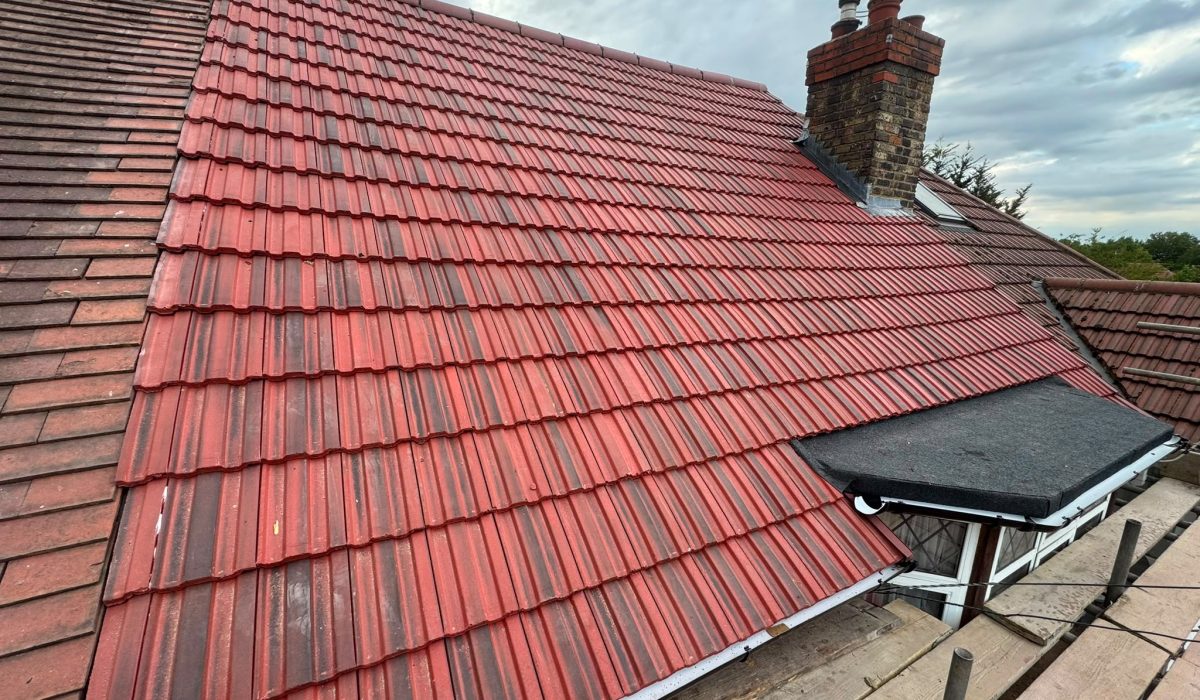
A leaking roof rarely announces itself with a dramatic drip. More often it starts as a faint stain, a musty smell in the loft or a patch of peeling paint, and by the time it is obvious, water may have been soaking into timbers and insulation for months. Catching a leak early is almost always cheaper, and far less disruptive, than dealing with the damage it leaves behind.
This guide explains how to spot the early signs, what usually causes leaks in London homes, what to do while you wait for a roofer, and how to tell whether you need a repair or a new roof.
Early warning signs of a roof leak
Water does not always drip straight down. It runs along rafters, battens and the underside of the roof covering before it finds a way through, so the stain inside is rarely directly below the hole outside. Look out for:
- Brown or yellowish rings on ceilings and upper walls, which often grow after rain
- Peeling wallpaper or bubbling paint where walls meet the ceiling
- A musty smell in the loft or top-floor rooms
- Damp or dark staining on roof timbers, or wet insulation
- Daylight showing through the roof when you look up from the loft
- Tiles or slates in the garden, in the gutters or on a lower flat roof
The most common causes
Slipped, cracked or missing tiles and slates
Wind, frost and age move tiles, and corroded fixings let slates slide. On older roofs that have no underlay, a single missing tile lets water straight into the roof space. Slate roofs can suffer from nail sickness, where the original nails rust away and slates start to slip across the roof.
Failed lead flashings
Wherever the roof meets something else, such as a chimney, a dormer or a wall, the junction is sealed with lead flashing. Lead lifts, cracks and splits with age, and where it has been patched with sealant the repair seldom lasts. Most roof leaks start at a flashing.
Blocked or damaged valleys and gutters
Valleys between two roof slopes carry a lot of water. Moss, leaves and debris can make water back up under the tiles, and a split lead lining will leak. Overflowing gutters soak the eaves and can look like a roof leak. See our guide to gutter repairs.
Cracked mortar on ridges and hips
Mortar bedding on ridge and hip tiles cracks and falls out over time. A dry-ridge system, which fixes the tiles mechanically, is the modern answer.
Flat roof failures
Blisters, splits, failed joints and ponding water are the usual culprits on extensions and garages. See our flat roofing page.
Condensation that looks like a leak
Not every damp patch is a leak. Poorly ventilated roofs and cold-deck flat roofs can cause condensation that drips and stains in the same way. A proper inspection tells the two apart.
What to do while you wait for a roofer
- Put a bucket or tray under any active drip, and move furniture and valuables away.
- If a ceiling is bulging with trapped water, you can make a small hole in the lowest point to let it drain, which is better than letting the ceiling collapse.
- Take photographs and notes of when and where the water appears, which helps your roofer and any insurance claim.
- Do not go on the roof yourself. Roofs are slippery and dangerous, especially when wet.
- Call a local roofer for an inspection. For urgent leaks we are available 24 hours.
How a roofer finds a leak
A good roofer inspects from the loft and from the outside. In the loft they look for wet timbers, stained insulation and daylight; outside they check flashings, valleys, ridges, tiles and abutments. A drone survey can photograph a steep or tall roof without scaffolding. The aim is to find why the roof is failing, not just where the water is coming in.
Repair or replace?
If the damage is localised and the rest of the roof is sound, a repair is usually the right answer. Replacement is better when leaks keep returning, when tiles are crumbling, when there is no underlay at all, or when battens and timbers are rotten. We would rather tell you honestly than sell a job you do not need, and we give both options in writing. See roof repairs and new roof installation.
Beware of cold callers
If someone knocks on your door and says your roof needs urgent work, be careful. Read our guide to spotting a roofing scam.
Get your roof checked
If you think your roof is leaking, call us on 020 3633 9588 or request a free quote. We cover Putney, Wimbledon and the wider South West London area, with free surveys and itemised written quotes.
Roof leak FAQs
Can a small leak wait until spring?
It is rarely worth waiting. Water that gets in over winter soaks timbers and insulation and can lead to rot and mould, which costs far more to put right than the original repair.
Why does my ceiling stain appear nowhere near the damaged tile?
Water runs along rafters, battens and the underside of the roof covering before it drips through, so the entry point and the stain can be several metres apart.
Is a leaking roof covered by home insurance?
Policies differ. Storm damage is often covered, while wear and tear usually is not. Keep photographs and invoices, and check your policy. Our drone surveys can provide dated photographs for a claim.
How fast can you attend a leak?
We are available 24 hours a day. Call 020 3633 9588 and we will make the roof watertight first.